Thursday, 15 December 2011
Thursday, 7 July 2011
AUDITORIUM opens at Brancolini-Grimaldi
Yesterday evening - Private View for Sophy Rickett's new solo exhibition which features AUDITORIUM in its first London installation. It's on at Brancolini-Grimaldi, 43-44 Albemarle Street, London, W1S 4JJ from 7 July to 27 August 2011.
Tuesday, 28 June 2011
Electronic sound
Electronic sound creates shifting perspectives. Colours are thrown into relief and become more nuanced. Or, it intervenes and cuts. This I have learnt from working on A Buried Flame and Auditorium.
Friday, 24 June 2011
Auditorium gets second live performance
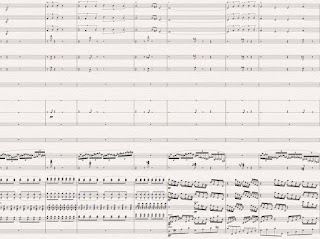
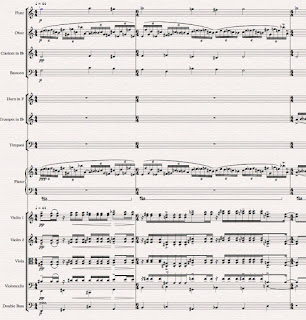
The University of Sussex Symphony Orchestra, conducted by Ian Mccrae, gave a bold and dramatic performance of AUDITORIUM (2007) - a film by Sophy Rickett with an orchestral and electronic score by Ed Hughes, commissioned by Glyndebourne and Photoworks - yesterday evening, 23 June 2011 in Mandela Hall, University of Sussex. It has been screened all over the world in galleries and other venues but this was its second performance with a real live orchestra and electronics (the first being the premiere by the Sussex Downs Youth Orchestra/Malcolm Warnes at Glyndebourne on 14 November 2007).
Thursday, 9 June 2011
A Buried Flame - new recording
Yesterday - a thrilling session recording with the New Music Vocal Ensemble conducted by John Hancorn, recording all four movements of A Buried Flame. In St Silas Presbytery, St Silas Place, London NW5 with the Classical Recording Company - Simon Weir (producing) and Morgan Roberts (engineering).
They found a brilliant solution to recording a 14 part chord with just 7 singers.
Monday, 7 February 2011
BFI release I Was Born, But...

In 2002 I made a score to a film by Ozu called I Was Born, But... for the Bath Film Festival. It was premiered with a live ensemble (the New Music Players plus the Fell Clarinet Quartet) in the Assembly Rooms in Bath in the Festival that year. In 2005 it had a revival in a 'touring' ensemble form (flute, clarinet, violin, cello, piano, percussion). A crack team from the New Music Players recorded the 2005 version last Summer, and this has just come out on the BFI label, supporting a blu-ray release of Ozu's later sound film, Good Morning. I added one sound effect to my I Was Born, But... score in 'post-production' - a passing train - to register aurally a visual pattern which runs through the film. The BFI release is here.
Thursday, 16 December 2010
BBC Singers perform Sun, New Moon and Women Shouting

Very exciting performance of my 1995 work Sun, New Moon and Women Shouting (to texts by poet and scholar Tom Lowenstein) yesterday. Robert Hollingworth conducted the BBC Singers at a concert called 'A Winter's Journey' at St George's, Campden Hill, London, and it was broadcast live on BBC Radio 3. This is the first time the piece has been done with a full chorus - it was originally written for I Fagiolini's six solo voices. This time it was as though a whole crowd of people were joining together to tell stories and and shout at the sun.
Wednesday, 29 September 2010
New Music Players recording
And I followed up the concert on Monday at Kings Place with a recording session yesterday with the same fabulous ensemble, New Music Players conducted by Patrick Bailey, crack musicians all of them. Working in St Michael's Highgate, with top classical producer Simon Weir, we recorded the now four movement/seven piece Chamber Concerto in a three hour session, followed by the version of Dark Formations from the Kings Place concert. The plan is to put the visuals and the music together for Dark Formations in order to demonstrate further possibilities for this mesmerising and disturbing material, beautifully sequenced by David Chandler, working with archive material from the Imperial War Museum. We finished the session with an electrifying straight take of Quartet, my eight minute clarinet/violin/cello/piano piece from 1998.
Tuesday, 28 September 2010
Dark Formations
Kings Place 27 September 2010 - collaborations with the brilliant New Music Players and Patrick Bailey, with film makers Adrian Goycoolea and Lizzie Thynne, and with David Chandler on the first exposure of 'Dark Formations. Found myself on local TV talking about the project with David and his work on the images from the Imperial War Museum.
Thursday, 22 July 2010
Surrealist Picnic II
Currently working on experimental collaborations for a concert at Kings Place as part of their Out Hear series on Monday 27 September 2010.
Lizzie Thynne, working with editor Peter Harte, has made a wonderful short film about artist and photographer Claude Cahun's imagined intervention at the surrealist picnic, pictured by Lee Miller in 1937. Lizzie chose to use a movement from my Sextet (1999) and the result is a quirky, latter-day silent film, both enjoyable and poignant.
Monday, 19 April 2010
A Buried Flame - Extracts
Here is an audio montage of brief extracts from 'A Buried Flame' as performed by Bath Camerata conducted by Nigel Perrin. The four short extracts run continuously and use the following texts: (1) Psalm 69 (2) Ode to the Sea (3) Two Fragments (4) Homeward Bound. Extracts 2-4 are from 'Poems from Guantanamo' (Iowa, 2007) edited by Marc Falkoff, used by permission of the publisher. The work was commissioned by Bath Camerata with support from the PRS for Music Foundation. The music is copyright University of York Music Press, 2010.
Saturday, 3 April 2010
A Buried Flame

A Buried Flame finally had its first performance by the inspirational Nigel Perrin and Bath Camerata at Wells Cathedral yesterday. This was an ambitious piece and the choir gave it a phenomenal first performance. The cathedral was packed.
Photo of choir in rehearsal by Liz Webb.
Link to Swedish radio interview.
Saturday, 13 February 2010
Clarinet Trio
The Camilleri Trio performed my short Clarinet Trio (clarinet, piano, cello) in Southampton on Thursday evening, and I was there to record it. The performance was even faster this time, still lyrical but with a wonderfully rhythmic edge.
I was browsing the open source web site www.archive.org and came across this short film: A Colour Box by Len Lye, from 1935, commissioned by the General Post Office, to promote cheaper parcel post. According to a reviewer on archive.org, he 'worked directly on film, painting and scratching it without a camera'. How amazing to find a commercial organisation commission an avant-garde artist as part of its regular operation! And the result is timeless, mesmerising and completely modern.
I thought I would see what would happen if I introduced the Clarinet Trio to A Colour Box.
I was browsing the open source web site www.archive.org and came across this short film: A Colour Box by Len Lye, from 1935, commissioned by the General Post Office, to promote cheaper parcel post. According to a reviewer on archive.org, he 'worked directly on film, painting and scratching it without a camera'. How amazing to find a commercial organisation commission an avant-garde artist as part of its regular operation! And the result is timeless, mesmerising and completely modern.
I thought I would see what would happen if I introduced the Clarinet Trio to A Colour Box.
Friday, 11 December 2009
A Buried Flame
I am currently working on a new piece for the Bath Camerata Choir (directed by Nigel Perrin). This will be for their annual concert on Good Friday, 2 April 2010.
The piece is starting to take shape and I was able to work with a very fine student ensemble of singers and a bass guitarist today in the stunning Meeting House (the chapel at Sussex University). The aim of our session was to try out sections of the sketched score, and to work on phrasing, balance, and on bringing out the sharp contrasts (present in both the ancient and modern texts of this piece) between inward expression and anguished cries. I introduced the bass guitarist into the ensemble initially for practical reasons (holding pitch) but after today I am very drawn to the subtle inflections of timbre (ranging from bright to mellow to an inward, near-plucked sound) available from this instrument, as well as its astonishing cutting power.
I was very grateful to the singers involved in this practical session: Amanda, Gemma, Rose, Michelle, Liz, Duncan, and Mike on bass guitar. Hoping we can work on it again in the run up to the premiere by Bath Camerata.
The work will set a segment of Psalm 69, plus poems drawn from the collection 'Poems from Guantanamo' (University of Iowa Press, 2007, edited by Marc Falkoff) which documents the poetry of some of those interned over the last few years.
The section we tried today was from the opening of the piece (text - Psalm 69) and here is a short audio sample of our session:
The piece is starting to take shape and I was able to work with a very fine student ensemble of singers and a bass guitarist today in the stunning Meeting House (the chapel at Sussex University). The aim of our session was to try out sections of the sketched score, and to work on phrasing, balance, and on bringing out the sharp contrasts (present in both the ancient and modern texts of this piece) between inward expression and anguished cries. I introduced the bass guitarist into the ensemble initially for practical reasons (holding pitch) but after today I am very drawn to the subtle inflections of timbre (ranging from bright to mellow to an inward, near-plucked sound) available from this instrument, as well as its astonishing cutting power.
I was very grateful to the singers involved in this practical session: Amanda, Gemma, Rose, Michelle, Liz, Duncan, and Mike on bass guitar. Hoping we can work on it again in the run up to the premiere by Bath Camerata.
The work will set a segment of Psalm 69, plus poems drawn from the collection 'Poems from Guantanamo' (University of Iowa Press, 2007, edited by Marc Falkoff) which documents the poetry of some of those interned over the last few years.
The section we tried today was from the opening of the piece (text - Psalm 69) and here is a short audio sample of our session:
Wednesday, 25 November 2009
The Camilleri Trio
Trio for clarinet, cello and piano, was composed in memory of the distinguished musicologist and Berio expert David Osmond-Smith, who I worked with as a colleague at Sussex University for a time until his death in May 2007. This performance is by the Camilleri Trio performing on tour in Sweden at Västervåla kyrka (near Fagersta) on 11 August 2009.
I used to teach nineteenth century composition styles at Sussex, and once had an interesting conversation with David in which he put me on to the harmonic and polyphonic subtleties of Brahms' Intermezzos - an inspiring discovery for me. I therefore tried to capture some harmonic and polyphonic subtlety in this short work.
Trio for clarinet, cello and piano (2007)
Camilleri Trio
Joanne Camilleri (piano); Alison Hughes (clarinet); Anja Inge (cello)
I used to teach nineteenth century composition styles at Sussex, and once had an interesting conversation with David in which he put me on to the harmonic and polyphonic subtleties of Brahms' Intermezzos - an inspiring discovery for me. I therefore tried to capture some harmonic and polyphonic subtlety in this short work.
Trio for clarinet, cello and piano (2007)
Camilleri Trio
Joanne Camilleri (piano); Alison Hughes (clarinet); Anja Inge (cello)
Saturday, 21 November 2009
Is the score dead?
The composer Peter Wiegold recently came to the institution where I teach, Sussex University. He was talking on the subject of collaboration in music in a research seminar series I'm organising; and his particular concern is collaboration between musicians in performing contexts, and the means by which new musical forms of expression are achieved. He doesn't think the score is dead: unlike the policy-makers for schools' teaching of music, for whom I gather 'relevant' music is pop, he thinks there is a role for the score as a starting point. But he argues that the score only takes us back to Monteverdi, and that the players most highly esteemed for centuries were those capable of departing from the text. Peter Wiegold's projects with his own band notes inegales demonstrate the richness of this approach. Starting from a strong core, or centre, their collective compositions spin out into realms of unimagined beauty, using techniques of extrapolation and decoration, as though the ensemble itself is one unified but incredibly rich creative brain. I found Peter's talk suggestive and exciting. But for me the peculiar western invention, or myth, of the score, remains intriguing and attractive. I see it as the means by which a polyphonic conception of music, both ordered and complex, is generated and sustained. The particular achievement of notated western music is sustained, coherent and elaborate invention, capable of detaching itself from the known (the strong centre) and attaining the infinite. It is the act of writing, of martialing and projecting musical thought in time and space, which gives us Tallis's Spem in Alium, Mozart's Don Giovanni, Varese's Hyperprism, Bartok's Fourth Quartet, Ligeti's Le Grand Macabre. In this sense, perhaps, the composer's script is analogous in function to the playwright's script, to Shakespeare's, Joyce's, Beckett's...
Friday, 13 November 2009
Sound and Music future
On Monday I went to a meeting convened by the new 'Sound and Music' organisation in London. They are wondering what to do about their composers' representation schemes, 'New Voices' and 'Contemporary Voices', inherited from the British Music Information Centre, and now merged. At the moment it feels like the staff are uncertain what the future direction is and they are asking us. I think the staff should get to know their composers better and the composers should be more connected up. I suggested a once a year 'marathon' featuring all or a very big cross-section of the represented composers, free, and a bit like Bang on a Can in New York, which I happened to go to this year. The music was very variable but the atmosphere interesting, mixed, and there must have been a thousand people there at any one time, it being a free event and well supported by Time Out New York.
I must admit I regret the loss of the British Music Information Centre. London must be the only major capital city without an MIC now.
Friday, 6 November 2009
Farewell my lads and lasses: Tacet with Spiers and Boden
Over summer and autumn of 2008 I had the great pleasure of collaborating with the amazing Brighton-based Tacet ensemble. They had initiated a series of commissions inspired by English folk songs - responses to this material by contemporary performers and composers. Brainchild of their director Adam Bushell, they linked up with Spiers and Boden, a well known and acclaimed duo on the contemporary folk song circuit.
Resulting from this initiative four pieces were toured in Winter and Spring of 2008/9. The composers were Alison Kay, Jon Spiers, Jon Boden and myself. The music was recently broadcast on Resonance FM.
My own piece was inspired by 'Farewell Lads and Farewell Lasses', a folk song noted by Cecil Sharp in 1906 in Exford, Somerset, where it was sung by Robert Parish (1823-1909), then the sexton in the village. Scored for the six players of Tacet, flute, clarinet, violin, cello, piano, percussion, it also features Spiers and Boden on folk violin, voice, and melodeon. At the end of the piece a fragment of the original folk song is 'revealed', disappearing into the distance, as it were.
Here is an extract from the first part and final part of the piece. The film sequence is from The History of Wakes Weeks and the Easter Fair (Lancashire), produced by CBebenezer, fully available under Creative Commons license/public domain via archive.org.
Resulting from this initiative four pieces were toured in Winter and Spring of 2008/9. The composers were Alison Kay, Jon Spiers, Jon Boden and myself. The music was recently broadcast on Resonance FM.
My own piece was inspired by 'Farewell Lads and Farewell Lasses', a folk song noted by Cecil Sharp in 1906 in Exford, Somerset, where it was sung by Robert Parish (1823-1909), then the sexton in the village. Scored for the six players of Tacet, flute, clarinet, violin, cello, piano, percussion, it also features Spiers and Boden on folk violin, voice, and melodeon. At the end of the piece a fragment of the original folk song is 'revealed', disappearing into the distance, as it were.
Here is an extract from the first part and final part of the piece. The film sequence is from The History of Wakes Weeks and the Easter Fair (Lancashire), produced by CBebenezer, fully available under Creative Commons license/public domain via archive.org.
Thursday, 29 October 2009
Recording my Battleship Potemkin score
Following the first performances and 2005 tour of my nine piece score to Battleship Potemkin (the year of the eightieth anniversary of the film), in 2007 we made a multi-channel recording of the score for Tartan Video. This came out in a special 5.1 surround mix in DTS and Dolby Digital in a box set of Eisenstein's silent films. The recordings were engineered, mixed and edited in London by the Classical Recording Co., and performed by the New Music Players, conducted by Patrick Bailey. In the course of four days recording, we also recorded my score to Eisenstein's Strike for the DVD box set.
The film maker Aitor Antepara Zuza made a short film about the recording process which was included as an extra on the box set. Here it is.
Friday, 23 October 2009
Battleship Potemkin score premiere
Back in May 2005 (14 May, to be exact) the Brighton Festival presented the first performances of my new score to the complete film of Eisenstein's silent masterpiece Battleship Potemkin (1925), at the Engineerium in Hove, Sussex, UK. The new score was modelled on the originally tight ensemble line-up of Meisel's 1926 Berlin score, which Eisenstein supervised. I also used some of the ideas about rhythm and structure, which Eisenstein wrote about, as a result of working with Meisel. I chose an ensemble of flute, clarinet, horn, trumpet, cello, bass, piano and percussion - giving room for lyrical writing and also weighty and punchy brass, percussion and bass lines. Two years later, in 2007, I would complete a score for the identical ensemble to Eisenstein's earlier film Strike (1924). Both scores were recorded by my ensemble, The New Music Players, in 5.1 DTS and Dolby Digital, and released on Tartan Video in a box set, which is still available via Amazon.
This home movie documents the atmosphere that day in 2005, when the brilliant musicians of the New Music Players worked closely with the Festival's wonderful technical team to create a really exciting event, which sold out to two separate performances on the same day.
In these clips it is possible to spot the following amongst others:
Patrick Bailey, conductor; Rowland Sutherland, flute; Fiona Cross, clarinet ; Roger Montgomery, horn ; Ed Maxwell, trumpet ; Michael Atkinson, cello ; Paul Sherman, double bass ; Richard Casey, piano ; Chris Brannick, percussion;
Sound artist Pendle Poucher on laptop; Liz Webb, New Music Players manager talking to Chris Baker, projectionist and Festival Events Manager of Bath Film Festival; Gill Kay from Brighton Festival who commissioned the score.
Our performances were licensed by Contemporary Films.
This home movie documents the atmosphere that day in 2005, when the brilliant musicians of the New Music Players worked closely with the Festival's wonderful technical team to create a really exciting event, which sold out to two separate performances on the same day.
In these clips it is possible to spot the following amongst others:
Patrick Bailey, conductor; Rowland Sutherland, flute;
Sound artist Pendle Poucher on laptop; Liz Webb, New Music Players manager talking to Chris Baker, projectionist and Festival Events Manager of Bath Film Festival; Gill Kay from Brighton Festival who commissioned the score.
Our performances were licensed by Contemporary Films.
Thursday, 15 October 2009
New work-in-progress for chamber ensemble
I'm currently working on a new piece for a crack ensemble of fourteen players, which will eventually last about twenty minutes. I hope soon to have news of an initial performance in the south-east of the first section at least, and here is a clip (realised electronically).
Friday, 9 October 2009
As Dreams Begin
At the request of John Stringer I have recently been working on a new piece for solo oboe or solo flute, to go into a UYMP (University of York Music Press) volume of solo works designed for performance at university student level.
The piece is called As Dreams Begin which is a phrase from the poem Homeward Bound by Moazzam Begg, in 'Poems from Guantanamo' edited by Marc Falkoff (Iowa, 2007).
The work is about how a solo line can magically fill an expanded 'space' through the use of a very simple electronic technique, the delay effect. As the soloist plays, a recent segment of the sound picked up by a microphone is relayed and played against the new material that the soloist has gone on to play.
Liz Webb (flute) has helped me with the piece by playing through extracts to test them, and this movie gives an impression of the score and soundworld.
The piece is called As Dreams Begin which is a phrase from the poem Homeward Bound by Moazzam Begg, in 'Poems from Guantanamo' edited by Marc Falkoff (Iowa, 2007).
The work is about how a solo line can magically fill an expanded 'space' through the use of a very simple electronic technique, the delay effect. As the soloist plays, a recent segment of the sound picked up by a microphone is relayed and played against the new material that the soloist has gone on to play.
Liz Webb (flute) has helped me with the piece by playing through extracts to test them, and this movie gives an impression of the score and soundworld.
Friday, 2 October 2009
AUDITORIUM in Berwick-on-Tweed
I was in Berwick a couple of weeks ago helping to set up an installation of AUDITORIUM in their Film Festival. Very inspiring to be working with a small group of perfectionists, who installed the piece into an 'ice house' - a remarkable covered structure designed in the 18th century to store ice, so they could keep the salmon cool (fished out of the River Tweed) for shipping to London.
AUDITORIUM is a 22 minute film by Sophy Rickett, for which I created the continuous musical score which accompanies it. The piece was inspired by the architecture of Glyndebourne Opera House, and features plays of light and shadow as well as unseen voices (operatic and crew). It was commissioned by Photoworks and Glyndebourne.
Here is a picture of AUDITORIUM installed at the ice house in Berwick on 20 September 2009 (photo by Huw Davies):

On a completely different scale, here is a picture of AUDITORIUM being screened and performed live at Glyndebourne Opera House back on 14 November 2007 (photo by Richard Rowland):
AUDITORIUM is a 22 minute film by Sophy Rickett, for which I created the continuous musical score which accompanies it. The piece was inspired by the architecture of Glyndebourne Opera House, and features plays of light and shadow as well as unseen voices (operatic and crew). It was commissioned by Photoworks and Glyndebourne.
Here is a picture of AUDITORIUM installed at the ice house in Berwick on 20 September 2009 (photo by Huw Davies):

On a completely different scale, here is a picture of AUDITORIUM being screened and performed live at Glyndebourne Opera House back on 14 November 2007 (photo by Richard Rowland):
Tuesday, 26 May 2009
New trailer - Brighton Festival
Thursday, 2 April 2009
Cocteau In The Underworld - Trailer
This short video clip gives a flavour of the piece. The scenes are from our initial workshop in November 2008. You can see a Platform event, featuring extended scenes from the work-in-progress, performed live at the Brighton Festival on Monday 4 May 2009, at 9pm, in the Pavilion Theatre.
BOOK NOW.

There is now a Cocteau In The Underworld Facebook page. Do visit and join.
BOOK NOW.
There is now a Cocteau In The Underworld Facebook page. Do visit and join.
Tuesday, 31 March 2009
More on the cast for the Brighton showing
Jacqueline Varsey ‘beautiful and astonishingly natural’ Musical Opinion
Hannah Pedley's work has included Royal Opera House, Holland Park and Grange Park
Richard Scott ‘an outstanding young counter-tenor’ Independent
‘The excellent tenor Andrew Mackenzie-Wicks’ Guardian
“The cast was uniformly excellent... Owen Gilhooly suggested Eckbert's growing paranoia to scarifying effect” Blond Eckbert / Opera / July 06
Hannah Pedley's work has included Royal Opera House, Holland Park and Grange Park
Richard Scott ‘an outstanding young counter-tenor’ Independent
‘The excellent tenor Andrew Mackenzie-Wicks’ Guardian
“The cast was uniformly excellent... Owen Gilhooly suggested Eckbert's growing paranoia to scarifying effect” Blond Eckbert / Opera / July 06
Cast for Brighton Festival
The superb cast on Monday 4 May 2009 will be
Eurydice - Jacqueline Varsey
Princess Death - Hannah Pedley
Raymond - Richard Scott
Orpheus - Andrew Mackenzie-Wicks
Cocteau - Owen Gilhooly
Conductor - David Angus
Director - John Lloyd Davies
Repetiteur - Lindy Tennent Brown
Eurydice - Jacqueline Varsey
Princess Death - Hannah Pedley
Raymond - Richard Scott
Orpheus - Andrew Mackenzie-Wicks
Cocteau - Owen Gilhooly
Conductor - David Angus
Director - John Lloyd Davies
Repetiteur - Lindy Tennent Brown
Wednesday, 18 February 2009
Cocteau In The Underworld
I am working on a new opera with the writer Roger Morris. A section of the opera will be presented as a Platform work-in-progress event live at the Brighton Festival on Monday 4 May 2009 at 9pm, in the Pavilion Theatre, Brighton.
BOOK NOW.
There is now a Cocteau In The Underworld Facebook page. Do visit and join.
BOOK NOW.
There is now a Cocteau In The Underworld Facebook page. Do visit and join.
Labels:
contemporary music,
Ed Hughes,
Jean Cocteau,
opera,
Roger Morris
Subscribe to:
Posts (Atom)